Uncertain Times for Business and Investors, by Robert Higgs
I don't know how many times I have made the remark to friends and family that this Great Recession is occurring like a slow-motion movie. We saw the bodies sailing through the air in our peripheral vision--the Ken Lewises, the Alan Schwartzes, the Martin Sullivans, the Richard Fulds. The stock market implosion took several weeks to come crashing to the floor, and the resultant slow-blooming dust cloud looked thick and impenetrable from a distance, yet translucent and impressionistic up close. With our telephoto lenses we could capture snapshots of the flustered figures scurrying for cover, the fragmented federal institutions falling by the wayside, the thick unbreathable hot air billowing, and the knee-jerk uninformed decision-making with its domino effects.
There are good reasons to cast blame on multiple characters in this film. The financiers were short-sighted and egocentric--and they still are, with no market force intervention to change their behavior. The overseers were, and are, just as short-sighted and egocentric. No market forces ever touch their behavior, except maybe during elections. Even the central bankers were, if not shortsighted and egocentric, at least somewhat smug and over-confident, which is also to be expected since no market forces ever touch their behavior, except perhaps the flux and reflux of Presidential favor.
(Aside about central bankers: In spite of this huge macroeconomic booboo, these economic engineers of our monetary system seem as impervious as ever to the naked insufficiency of the academic tools at their disposal. One gets the feeling that their tinkering with monetary policy is the equivalent of NASA physics experts deciding they know enough right now to send a spaceship to Venus.)
Massive disruption is common in boom-bust business cycles, but in the more minor cycles the cool wind of reality has managed to blow away the burning dust so we all could get back to business within a reasonable period. This time, however, just as in the 1930s, things are not clearing up. I can see two big reasons why.
First of all, in both Great Events we did not take our just desserts. We could have bowed to natural forces and let the excess speculative credit blow out of the system by allowing the big investment houses to go bust and putting up with a really bad year of unemployment and disarray. If we had done this, we would have feared the worst while it was happening, and some pretty innocent people would have suffered just as they indeed have; but after a few months business would have been able to pick up the pieces and get back to work on a more sound monetary foundation. In this hypothetical scenario--quite imaginary and improbable--the government would have done little except perhaps review its choice of central bankers and its banking system.
Instead, we panicked. Certain players, feeling the finger of blame turning towards them were they to do nothing, threw more credit at an already full-to-bursting credit bubble. By doing so we propped up the misaligned investment houses (in the process, creating another precariously speculative Wall Street finance house-of-cards and another salary bubble), and we shifted the malady from the private to the public sector in the hope that the world's credulity and our credit will hold up for at least one more election cycle.
Secondly, and most unfortunately, our 2008 election results made Congress believe that our political pendulum has swung to the government-interventionist side; but this is a misreading of public sentiment. What the politicians have mistakenly interpreted as a national tendency to look to government for solutions to all problems has caused them to take a number of actions that are putting off even further any hope of a return to reality. It's the borderline alcoholic going on the biggest binge of his life in order to cure his withdrawal symptoms.
The binge won't last. This political pendulum swing won't rest long at the apex. By 2012, there will be a new Congressional mix. But until then, I ask you: What businessperson in his or her right mind would invest for the longer term under the present conflictual circumstances?
Robert Higgs of the Independent Institute has a wonderful byline for our current malaise: Regime Uncertainty, he calls it. He wrote a paper on this topic in the spring of 1997 that is finally getting some well-deserved attention. In his more recent commentary "Regime Uncertainty--Now Maybe People Will Take The Idea Seriously," he notes:
"[B]usinesspeople may be more or less 'uncertain about the regime,' by which I mean, distressed that investors’ private property rights in their capital and the income it yields will be attenuated further by government action.... [T]he security of private property rights rests not so much on the letter of the law as on the character of the government that enforces, or threatens, presumptive rights. 'What does provide some degree of protection,' notes Andrzej Rapaczynski (1996), 'is the political system, together with the economic pressure groups that ensure that the state does not go “too far” in interfering with the owner’s control over assets. This politically determined thin line may be understood as the real definition of property rights conferred by the state, as distinct from the somewhat fictitious legal notion of property rights. How broadly property rights are defined in this real sense and how effective states’ (largely nonlegal) commitment is to their security is a more serious problem than the issue of legal protections against the more traditional form of takings. (93)'"
See also Higgs's article about the Great Depression entitled "New Deal Orgy No Model For Current Binge," in which he writes:
"The reason the Depression lingered long after the Roosevelt administration launched its hydra-headed recovery effort was because businesspeople in general, and investors in particular, feared the president’s assault on private property rights posed a potentially fatal threat to the market system."
This rings true for today's circumstances. Professor Higgs has done some excellent analysis of business cycles. In and of themselves, busts tend to create political turmoil no matter what the existing environment. That we should have havoc today, therefore, is not surprising given the scope of this event.
So, like our businesspeople, until I see respect for property take its deserved spot on our political agenda, I will not invest in our economy. In the meantime, give me a safe haven. I am not an investment adviser, but in times like these when no one can be sure whether we are headed for a flight from the dollar (or from all paper currencies), or towards another huge wave of inflationary misalignment that just puts off the day of reckoning for another decade, or for the third option that is a decade of Japanese-style stagnation with a big question mark at the end, I can see no better investment than gold and gold-related assets.
It's true, their price will tend to fluctuate in terms of paper currencies, and the politicians will always find ways to tax away any real advantages; but the underlying gold will never lose its innate value, no matter which politicians are in charge.
Monday, March 29, 2010

Friday, March 12, 2010
‘Swap Tango’ – A Derivative Regulation Dance: Part 2...
Satyajit Das Mar 10, 2010 11:53AM A question of values …
Derivative contracts are valued on a mark-to-market ("MtM") basis. This requires valuation of the contracts based on the current market price.
OTC derivatives trade privately. Market prices for specific transactions are not directly available. This means current valuations rely on pricing models.
In current accounting argot, most derivatives are Level 2 assets (Mark-to-Model). In practice, this means that they cannot be priced based on quoted trade prices (Level 1) but are valued using observable inputs; for example, comparable assets or instruments or using interest rates, volatility, correlation, credit spreads etc that can be put through an accepted model to establish values.
There are significant differences in the complexity of the models and the ability to verify and calibrate inputs. More complex products used sophisticated financial models, often derived from science or statistical methodology. There are frequently differences in choice, exact factorisation and even numerical implementation of the models. Different dealers may use different models.
Some required inputs for the models are available from markets sources. The nature of the OTC market and the limited trading in certain instruments mean that key input parameters must frequently be "estimated" or "bootstrapped" from available data. In certain products, the limited number of active dealers means that "market" prices are sometimes no more than the dealer’s own quote being fed back after being collated and "scrubbed" by an external data provider. This is referred to prosaically as "mark-to-myself".
Model variations and small differences in input can frequently result in large changes in values for some products.
The models make numerous assumptions including the ability to borrow at market rates for (theoretically) infinite amounts, unrestricted ability to enter into transactions and abundant trading liquidity. These assumptions are difficult to satisfy in practice.
For example, a key assumption of derivative valuation is that a transaction can be hedged with a counterparty or through other means at all times. In late 2008, in the aftermath of the collapse of Lehman Brothers and problems at AIG, market liquidity dried up and made it impossible to source market prices or transact in many instruments.
Model based valuations drive pricing of transactions and dealer hedging. They also are used to calculate the risk of the transactions and ultimately to derive the capital required to be held for regulatory and internal purposes.
The model-based valuations are also used to determine earnings and ultimately bonus payments for dealer staff. In Warren Buffet’s inimitable words this allows the dealer to see "… where the arrow of performance lands and then [paint] the bull’s eye around it".
Non-professional dealers rarely have the required sophisticated pricing and valuation systems. They are dependent upon valuation date (predominantly) supplied by dealers or (less frequently) rely on pay-as-you-go pricing services.
Investors use the model-based prices to generate values for their fund units. Investors transact at these model-based prices when they invest or redeem investments
The accuracy and tractability of derivative valuation, especially for complex products, is questionable.
MtM prices may be also prone to manipulation. Recent disclosures about events leading up the government bailout of AIG highlight potential problems.
There is limited internal or external (auditors and regulators) oversight of the models. This reflects, in part, the complexity of the models and the scarcity of experienced professionals capable of undertaking such reviews.
Widespread reliance on models and MtM methodology is perhaps surprisingly an unquestioned article of faith in financial markets. It allows immediate recognition of gains and losses that will accrue over many years immediately. After his purchase of Gen Re and discovery of the problems surrounding its derivatives operations, Buffett remarked: "I can assure you that the marking errors in the derivatives business have not been symmetrical. Almost invariably they have favoured the trader who was eyeing a multi-million dollar bonus … Only much later did shareholders learn that the reported earning were a sham."
Interestingly, MtM accounting is generally not available outside of financial instruments. An often neglected element of the Enron scandal was the company’s ability to convince its auditors and the U.S. Securities and Exchange Commission ("SEC’) to allow MtM accounting to be used in the natural gas industry. This allowed the company to record current earnings based on the future value of long term contracts.
Current regulatory proposals do not attempt to deal with the pricing, valuation and model issues. As Daniel C. Gelman observed: "Where secrecy reigns, carelessness and ignorance delight to hide."
Stand by Me …
In derivative contracts, each party takes the credit risk of the other side in terms of performing their obligations. This is known as counterparty risk. The failure of Lehman Brothers and a number of banks during the Global Financial Crisis ("GFC") highlighted the problems of counterparty risk in derivatives.
Counterparty risk in derivatives is different from credit risk generally. In a loan, the lender is exposed to the risk of the borrower failing to pay interest or repay the known face value of the loan. In contrast, in most derivative contracts (other than options), the risk is mutual with both parties being exposed to the risk of non-payment by the other.
Counterparty risk is complex because the payment obligations between the parties are contingent. The quantum and the direction of payments depend on market price movements. The potential counterparty risk is not known in advance and is apparent only when actual price movements occur. In practice, this requires parties to estimate the potential exposure using mathematical models based on the expected evolution of the relevant market prices.
In the 1980s when derivative markets developed, counterparties were generally of high credit quality. This had the effect of reducing, although not eliminating, counterparty risk.
Over the last two decades, the derivatives market has becoming more democratic. Entities with lower credit ratings have become active users of derivatives. This includes highly leveraged investors, such as hedge funds and private equity funds. Participation of these riskier entities has entailed reliance on credit enhancement techniques.
The primary form of credit enhancement is the use of bilateral collateral. This entails counterparties posting collateral in the form of cash or high quality securities to secure the current value of the contract. The collateral acts as surety against non-performance under the contract. Collateral arrangements are highly customised. For example, AIG’s collateral arrangements required the firm to post collateral only where the exposure under the contracts increased above an agreed level or AIG’s credit rating was reduced below a specified quality.
Other credit enhancement techniques used include a right to break that allows either party to terminate the contract under certain credit-related circumstances. Any such termination is at market values triggering an obligation of one party to pay the other party the current value of the contract.
Counterparty risk and credit enhancement techniques are predicated on the same models used for pricing and valuation. Use of bilateral collateral relies on the accuracy of valuations and risk models. It also relies on certain and enforceable legal rights in respect of collateral and proper management of the cash and security lodged.
The GFC, especially the bankruptcy filing of Lehman Brothers, provided a test of counterparty risk in derivatives. The quantification and management of such risk proved problematic. The quantum of credit risk from derivatives was higher than model based estimates as market volatility increased and correlations between risk factors moved erratically. Legal enforceability, control and management of collateral also experienced problems.
Current regulatory proposals focus heavily on counterparty risk issues. The central legislative reform proposed is a central clearinghouse - the central counterparty ("CCP"). The BIS also proposed changes in capital requirements against counterparty risk in the light of recent experience.
Under the CCP arrangements, "standardised" derivative transactions must be transferred to an entity that will guarantee performance. In a curious circularity, standardised means anything that is eligible for and can be "cleared". Interesting inclusions and exclusions – both in terms of products and parties that must trade through the CCP – are to be found. The arrangement centralises contracts in a single entity, the ultimate case of "too big to fail".
The CCP implements risk management systems to manage its exposure under derivative contracts.
The CCP will be reliant on risk models and the ability to value contracts. As noted above, there are significant issues in pricing and valuing contracts and, for some products, reliance on complex models.
The CCP proposal relies heavily on "self-confidence", which as Samuel Johnson observed is "the first requisite to great undertakings." In relation to the CCP, legislators and regulators are basing their approach on Lillian Hellman’s helpful advise: "It is best to act with confidence, no matter how little right you have to it."
One (Not Very Nice) World…
The GFC, in line with previous derivative crises including the collapse of Long Term Capital Management ("LTCM"), revealed deep fault lines in financial markets.
Derivative markets entail complex chains of risk that link market participants. This is similar to the re-insurance chains that proved problematic in the case of Lloyd’s Insurance market problems. In both markets, the risks are both potentially significant and "long tail", that is, they do not emerge immediately and may take some time to be fully quantified.
As in the re-insurance market, the long chain of derivative contracts can create unknown concentration risks. This is exacerbated by the highly concentrated structure of derivative trading. It is likely that for each product or asset class a few dealers (less than 10-12 and sometimes as few as 4-6) account for the bulk of trading. This means that financial problems or uncertainty about any major dealer could cause the financial system to become gridlocked as uncertainty about counterparty risks restricts normal trading.
Current regulatory proposals have not focused on the issue on inter-connected trading and concentration risk other than as a by-product of the CCP proposal. It is widely believed that the CCP will improve the market structure. In reality, the CCP becomes a node of concentration. In addition, to the extent that products are not routed or counterparties are not obligated to trade through the CCP, the problems remain and may increase.
A central problem of the current derivative markets is potential liquidity (cash or funding) risks. Ironically, the problems derive, in substantial part, from the desire to reduce counterparty risk through credit enhancement procedures, such as bilateral collateral.
Where derivative contracts are marked-to-market daily and any gain or loss covered by collateral to minimise performance risk, movements in market rates can trigger large cash requirements. These requirements may be unanticipated. If there is a failure to meet a margin call then the position must be closed out and the collateral applied against the loss. This may leave the parties unhedged against underlying risks or on offsetting positions creating the risk of additional losses.
For example, ACA Financial Guaranty sold protection totalling US$69 billion while having capital resources of around US$425 million. When ACA was downgraded below "A" credit rating, it was required to post collateral of around US$ 1.7 billion. ACA was unable to meet this requirement.
AIG’s CDS contracts were subject to the provision that if the firm was downgraded below AA- then the firm would have to post collateral. In October 2008, when AIG was downgraded below the nominated threshold, this triggered a collateral call rumoured to be around US$14 billion. AIG did not have the cash to meet this call and ultimately required government support. The problems at ACA and AIG are not unique.
Current regulatory proposals do not address liquidity risks in derivative markets. Interestingly, the CCP may inadvertently increase liquidity risk as more participants may be subject to margining and unexpected demands on cash resources. The BIS has proposed an extensive regime of liquidity risk management controls that would, in part, cover some liquidity risks.
Failed Plumbing…
The GFC has exposed long standing and significant problems with the infrastructure of derivatives markets.
In 2006, Alan Greenspan expressed shock and horror at the state of settlements in the credit derivative market. He expressed surprise that banks trading CDS seemed to document trades on scraps of paper. The ex-Chairman, perhaps unfamiliar with the reality of financial markets, had difficulty reconciling a technologically advanced business with this "appalling" operational environment.
Derivative systems and trade processing are generally inadequate, with infrastructure lagging well behind innovation. Delays in documenting contracts forced regulators to step in requiring banks to confirm trades more promptly. The accuracy of the mark-to-market values of contracts, particularly of less liquid and infrequently traded reference entities, is not unimpeachable. Where collateral is used, as noted above, monitoring and management of collateral poses significant risks.
Current regulatory proposals seek welcome improvements processes and systems for derivative trading.
Derivative contracts are documented under the International Swap and Derivatives Association ("ISDA") Master Agreement. The ISDA Agreement has been remarkably successful in standardising documentation of trading.
The contract has not been tested under stressful conditions such as those of the GFC. A number of issues have emerged.
The bankruptcy of Lehman Brothers and resulting unwinding of complex derivative arrangements has exposed problems of derivative and bankruptcy law, especially in cross-border, multi-jurisdictional transactions. The GFC also exposed issues relating to the documentation of specific derivative contracts, such as CDS contracts, and the impact on bankruptcy and resolution of financial distressed firms.
Current regulatory proposals do not address any of these documentary issues.
Bank regulatory capital has long distinguished between banking (loans or hold-to-maturity assets) and trading books (trading or available-for-sale assets). Differing capital rules between the banking and trading books encouraged regulatory arbitrage, generally using derivative structures to reduce the required level of capital. The BIS has addressed some regulatory anomalies, increasing the capital required against derivative positions.
Regulatory initiatives continue to emphasise improved disclosure of derivative contract. There is already significant disclosure, although much of it is incomprehensible and lacks utility. Additional disclosure will not significantly reduce systemic risks of derivatives.
On 25 September 2002, speaking at the U.K. Society of Business Economist while in London to collect an honorary knighthood for contribution to economic stability, Alan Greenspan outlined the case for less transparency: "…paradoxically, the full disclosure of what some participants know can undermine incentives to take risk, a precondition to economic growth….to require disclosure of the innovative product either before or after its introduction would eliminate the quasi-monopoly return and discourage future endeavours to innovate….market imperfections would remain unaddressed and the allocation of capital to its most productive uses would be thwarted."
Greenspanargued that even "disclosure on a confidential basis solely to regulatory authorities may well inhibit…risk taking." Dealers will undoubtedly resist meaningful disclosure prejudicial to their economic interests.
Regulatory initiatives do little to address the quality of regulators and the acuity of oversight. The absence of suitably expert and experienced regulators will undermine regulatory and legislative initiatives. Given the shortage of talent in derivatives generally and the pay grades of regulators, it will be difficult for regulatory agencies to properly supervise dealers and derivative activity. In terms of an old Spanish proverb "Laws, like the spider's web, catch the fly and let the hawk go free."
Regulatory Tango…
Debate over regulation of financial services has taken on a frenzied tone. Regulators and think tanks are producing voluminous, overlapping and (sometimes) contradictory proposals. Regulatory agencies are jockeying for position, sometimes forming unlikely coalitions to preserve or expand territory. In the U.S. Congress, multiple bills and several committees are jostling to make sense and harmonise complex and irreconcilable draft legislation. Activity and achievement are confused.
Banks and their lobbyists do not believe that there is a case for regulation. In William Davenant’s words: "Had laws not been, we never had been blam'd; For not to know we sinn'd is innocence."Banks argue that the complex nature of derivative trading dictates that self-regulation is the only feasible approach. If that fails, then banks seek to minimise scrutiny of major issues, such as the size of the market, speculative activity, pricing issues, complexity and mis-selling of derivatives to unsuitable clients. They argue that existing regulations already adequately cover some issues. Proposed regulations will be masterfully narrowed to minimise impediments to profitable activities.
There will be a familiar threat. Lack of international agreement and regulatory uniformity makes compliance impractical. Banks and derivative activity will relocate with losses of jobs and taxes to the host country. Familiar arguments will be heard regarding the loss of competitive advantage, diminished financial innovation, slower capital formation and higher cost of capital. Each is a well-known step in the familiar "regulatory tango".The complexity of the issues means that ultimately no laws may be truly effective. As one famous law maker, Adlai Stevenson, observed "Laws are never as effective as habits."
Groucho Marx observed that "[government] is the art of looking for trouble, finding it, misdiagnosing it and then misapplying the wrong remedies." Legislators and regulators are likely to discover the truth of that proposition in their attempts to regulate the derivative market.
An earlier version was posted on www.eurointelligence.com.
‘Swap Tango’ – A Derivative Regulation Dance: Part 1...
Satyajit Das Mar 8, 2010 12:18AM
On 30 July 1998, Alan Greenspan, then Chairman of the Federal Reserve argued that: "Regulation of derivatives transactions that are privately negotiated by professionals is unnecessary." In October 2008, the now former Chairman grudgingly acknowledged that he was "partially" wrong to oppose regulation of credit default swaps ("CDS"). "Credit default swaps, I think, have serious problems associated with them," he admitted to a Congressional hearing. His current views on wider derivative regulation remain unknown.
Politicians and regulators globally are currently busy drafting laws to regulate derivatives. A common theme underlying the activity is an absence of knowledge of the true operation of the industry and the matters that need to be addressed. As Goethe observed: "There is nothing more frightening than ignorance in action."
The author Thomas Pynchon warned: "If they can get you to ask the wrong questions then the answers don’t matter." Simplistic causes and solutions may prevent real issues in relation to derivatives from being debated and dealt with.
Size Matters …
Based on surveys conducted by the Bank of International Settlements ("BIS"), the global derivative market as at June 2009 totalled US$605 trillion in notional amount. This is a large increase in size from less than US$10 trillion 20 years ago. The bulk of the activity takes place in the Over-the-Counter ("OTC") market where derivatives are traded privately and on a bilateral basis between banks and clients. The OTC market should be contrasted with the exchange traded market where relatively standardised products are traded on formalised, regulated exchanges.
The outstanding amount compares to global Gross Domestic Product ("GDP") of around US$ 55-60 billion. As author Richard Duncan points out in his 2009 book The Corruption of Capitalism, the outstandings in the global derivatives market at its peak in June 2008 (US$760 trillion) was equal to "everything produced on earth during the previous 20 years."
Volume estimates are affected by double and triple counting and other statistical problems. There are also significant disagreements about the significance of the size numbers.
Derivative professionals argue that derivative notional amounts (the face value of the contract) are a stock measure (like assets and liabilities). GDP is a flow measure (i.e. income). So strictly speaking they are not directly comparable.
Derivative professionals also argue that the outstanding value is irrelevant as it is only the notional face value of contracts. They focus on the current value (around US$25 trillion) that can be further reduced after netting between dealers to around US$4-5 trillion. If the US$4 trillion in collateral (cash and government securities) held to secure the current value is considered, then they argue that the exposure is a negligible amount.
In effect, there is no risk. The size of the market doesn’t matter. As Laurence J. Peter author of the famous Peter Principal stated: "Facts are stubborn things, but statistics are more pliable."
Current value is a calculation of the worth of the derivative contract if terminated today. It provides a useful measure of current price and risk.
The notional amount represents the actual amount of underlying assets that the trader is exposed to. The notional face value is the essential starting point of market size and any measure of leverage. The size of the market is inconsistent with the thesis that derivatives are merely a vehicle for hedging and risk management.
Current regulatory proposals do not attempt to deal with the size of the derivatives markets. The current debate about "too big to fail" banks may indirectly affect the size issue.
Approached to provide government aid to a company that claimed it was to big to fail, Richard Nixon advised: "get smaller!" Derivative regulators would do well to heed Nixon’s advice.
Grand Speculations…
Proponents argue that derivatives are used principally for hedging and arbitrage. In this way, they perform an economically useful function aiding capital formation and reallocating risk to those willing and better able to bear them. While they can be used for this purpose, derivatives are now used extensively for speculation, that is, manufacturing risk and creating leverage.
Stripped of quantitative hyperbole, derivatives enable traders to take the risk of the asset without the need to own and fund it. For example, the purchase of $10 million of shares requires commitment of cash. Instead, the trader can instead enter a total return swap ("TRS") where he receives the return on the share (dividends and increases in price) in return for paying the cost of holding the shares (decreases in price and the funding cost of the dealer). The TRS requires no funding other than any collateral required by the dealer; this is substantially less than the $10 million required to buy the shares. The trader acquires the same exposure as buying the shares but increases its return and risk through leverage.
Derivative volumes are inconsistent with pure risk transfer. In the CDS market, volumes were in excess of four times outstanding underlying bonds and loans. In the currency and interest rates, the multiples are higher.
Investors searching for return drive speculation. Concerned about stagnant real incomes and inadequate retirement savings, individual investors seek out higher yielding investment structures, often based on derivatives. Pension funds and other institutional investors use derivatives to enhance returns to fully fund and meet their contracted liabilities. In an environment of diminishing returns and fierce competition for attractive investments, fund managers use derivative strategies to enhance returns through readily accessible leverage and capacity to create risk "cocktails".
Facing increased pressure on earnings, corporations have increasingly "financialised", resorting to speculative derivative trading to meet profit expectations.
This pattern affects small companies as well as large companies. It is also evident in emerging as well as developed economies. In China, India and Korea, companies resorted to aggressive derivative strategies to augment earnings as profit margins on products were relentlessly forced down by competition and buyer pressure. Some strategies have led to significant losses.
The competitive advantage, if any, enjoyed by investors and corporations in speculative trading, especially in complex derivatives is unclear. Perhaps it is a lack of "horse sense" which as stated by Raymond Nash is "what keeps horses from betting on what people will do."
Proponents argue that speculators facilitate markets and bring down trading costs, thereby helping capital formation and reducing cost of capital. There is little direct evidence in support of this proposition. Recent experience suggests that in stressful conditions speculators are users rather than providers of scarce liquidity.
Given derivatives are second order instruments deriving its value from underlying assets, the argument regarding liquidity is curious. In many cases, the derivative contract is far more liquid than the underlying debt, shares, currency or commodity. This is consistent with trading in derivatives having a significant non-hedging, speculative element.
Speculative activity amplifies rather than reduces volatility and systemic risks. Perversely, this may impede capital formation and also increase the cost of capital for companies.
A reduction in speculative activity would also arguable free up capital tied up in trading. This capital could be deployed more effectively within the economy.
Control of speculative activity in derivatives is feasible. This would require traders to show an underlying risk as a pre-condition to entering into a derivative contract. In the case of investors, it would also require the derivative contract being covered fully with available cash or other securities.
The concept is used extensively in the insurance markets. A similar concept is embedded in the hedge accounting standards currently in use.
Current regulatory proposals do not attempt to deal with speculative activity in the derivatives markets. Some U.S. insurance regulators have proposed controls on speculative activity in certain derivatives, such as CDS, by requiring an underlying position. The Obama Administration’s proposed "Volcker Rule" prohibiting major banks engaging in proprietary trading may, if implemented, affect speculative activity in derivatives.
Amusingly, dealers now argue that the bulk of trading activity is actually for hedging purposes. It may have something to do with a more elastic definition of "hedging". No evidence was offered. Dealers were probably following Mark Twain’s advice: "Get your facts first, and then distort them as much as you please." In reality, probably no more than 10-20% of activity in the derivative markets is related to hedging.
Spoilt for choice…
Relatively simple derivative products provide ample scope for risk transfer. Standard forwards or options will generally complete markets and provide the ability to manage risk. The proliferation of complex and opaque products is prima facie puzzling.
In the 1950s, two economists, Kenneth Arrow and Gerard Debreu, proposed a theoretically perfect world - known as the Arrow-Debreu theorem. To attain the nirvana of economic equilibrium, the theorem required there to be securities for sale for every possible state of the future – "state securities". There should be contracts to buy or sell everything at any time period in every place until infinity or the end of the world, whichever was first. This utopian worldview provides the justification for allowing any and every type of derivative markets to be created.
Dealers argue that such structures are created in response to customer demand and to provide "financial solutions". In my experience, clients rarely ask to be shown a US$/ Yen big figure stop with double-barrier conditional accumulator (with or without Elvis Presley pelvic thrusts). Complex structures are designed and sold (often aggressively) by dealers.
The major drivers for complex products are increased risk and leverage. Some structures are also designed to circumvent investment restrictions, bank capital rules, and securities and tax legislation.
A key issue is the use of "embedded" leverage. These arrangements are used to provide leverage to investors and corporations whose internal or statutory rules prevent borrowing to finance increased investments. Derivative technology is deployed to increase gains and losses for a particular event (such as a change in market prices of an asset) in accordance with customer requirements to provide the effects of leverage without transgressing their investment mandates.
Proposals to control bank leverage, in broad terms, lack understanding of the issues of embedded leverage and its use in financial markets.
Complexity is also related to profitability of derivative trading. On 19 March 1999, Alan Greenspan speaking at the Futures Industry Association Conference at Boca Raton, Florida remarked: "… the profitability of derivative products has been a major factor in the dramatic rise in large banks’ noninterest earning and … the significant gain in the overall finance industry’s share of American corporate output… the value added of derivatives themselves derives from their ability to enhance the process of wealth creation."
The former Fed Chairman’s statement showed an alarming lack of understanding of the real sources of derivative trading profits. Many financial products are opaque and priced inefficiently to produce excessive profits – economic rents – for dealers. Efficiency and transparency is not consistent with high profit margins.
The majority of derivative transactions are standard and "plain vanilla" earning low margins with dealers relying on volume for profits. The bulk of dealer profitability comes from a few complex products. They also feed trading in standard products as dealers manage and re-allocate their risk from more structured transactions.
Complexity is also related to mis-selling of derivative products. Arcane structures create significant information asymmetry. Mis-selling of "unsuitable" derivative products to investors and corporations remains a problem. Expertise of purchasers is sometimes inversely related to the complexity of derivative products.
Currently, there are numerous disputes concerning derivative transactions between banks and their clients at various stages of litigation and a significant source of earnings to litigation lawyers. It is difficult to identify the causes – client greed or ignorance versus dealer greed or misrepresentation.
Current regulatory proposals do not deal with the issue of complexity in derivative products. Regulators could have forced standardisation and listing of derivative contracts, only allowing them to be traded on exchanges. They have favoured, probably correctly, the need to customise products and structures for users and their needs.
In relation to product suitability, the BIS have proposed "pharmaceutical" style warning systems, which do not address the problem. Given significant information and knowledge asymmetry between sellers and buyers, the possibility of disallowing certain types of transactions altogether or with certain parties should be considered.
Such proposals are likely to be unacceptable as inconsistent with "freedom of choice". "Free market" advocates are likely to side with the view of an anonymous commentator: "Nine out of ten people who change their minds are wrong the second time too."
An earlier version was posted on www.eurointelligence.com.
Sunday, March 07, 2010
Part 4: A Course of Action...
Part 4: A course of action
by Gordon RingoenMarch 05, 2010
Last of four parts
There are no silver bullets to solve our looming energy crisis, resource depletion, and environmental pollution. But, there are surely better courses of action. Major problems are not solved, but we can create an environment whereby solutions evolve. The following 12-step program is a beginning to keep us on course as the most prosperous nation in the world.
1.Disabuse the bankrupt economic theories that neglect the importance and limitations of our resources, environment, and quality of life while lionizing economic growth.
The continued devotion to outdated and discredited economic theories result in situations like the reported advice former Fed Chairman Alan Greenspan gave to U.S Treasury Secretary Tim Geithner that the government should simply buy houses and then bulldoze them to solve the housing crisis.
2.Throw out the notion that "free markets" will solve our energy and environmental problems.
Businesses have neither the interest nor resources. Market participants are motivated by short-term profits, which are their mandate, not in solving societal problems. I hate to break the Adam Smith myth that there is actually no "invisible hand" that works for the good of all as long as everyone only looks out for their self-interest. The actions necessary to deal with these monumental issues must come, dare I say it, from good government.
3.Students must demand that they be taught economics that deal with the real world and that can be substantiated with actual data and analysis.
They must resist theories that serve special interests, political, and economic doctrine. Students must lead, because the self-serving, symbiotic relationship that exists between academia, government, and business will resist any approach that threatens their controlling position. In other words, don’t expect Bernanke or Mankiw to propose a revolutionary, real-world view of economics.
4.Young adults must demand and force good government.
The younger generations have the most to gain and the least to lose by replacing our dysfunctional Congress and state legislators. They also have the energy and power to effect the change.
In addition to Congress, the largest and most prosperous states of California and New York are virtually paralyzed by weak and partisan politics. A Republic, such as ours, is totally dependent on sober, intelligent lawmakers who will devote a portion of their life in public service for the good of the populace and to serve national interests. Those lawmakers that are slaves to special interests, religious and political doctrine, and dogma must be given their walking papers regardless of party.
It is instructive that two of the most thoughtful legislators contributing to intelligent political discourse are Ron Paul and Bernie Sanders. Though they are at the opposite ends of the political spectrum, they both have fresh and informative views because they are independent thinkers and neither party nor political dogma dictates their views.
In addition, we need political leaders that are intelligent. When long time political pundit, Seymour Hirsh, was asked the difference between members of Congress today and 50 years ago, he said, "Their IQ is 35 points lower today!" The issues we face today are complex and we need leaders that have intelligence, aptitude and the work ethic to deal with them.
5.Demand the fundamental democratic principle of majority rule is re-established.
Do away with the self-imposed 60-vote filibuster process in the Senate. In the 1960s, filibuster entered into an average of six pieces of legislation per year. Last year, there were 120. This has essentially brought the legislative process to glacial speed while totally distorting the legislation itself. The filibuster makes us suffer from the tyranny of the minority as we have seen in the so-called "Health Care" bill.
And, overturn the two-thirds vote requirement for tax increases that have paralyzed the governance of California. California can only pass a budget that is filled with so much fiction that makes it essentially useless as a financial plan. California will go broke without major constitutional changes and its repercussions will be felt throughout our economy.
6.Stop the influence of business and other special interest groups in elections and legislation.
Corporations are not citizens and therefore must not be able to use their unlimited media and financial resources to mold the government to suit their pecuniary interests. Business lobbyists have no interest in the public good or the national interest, only in the financial advantage or doctrine of their employers. There are currently 10 times as many lobbyists in Washington as there are legislators. The financial industry alone spent $336 million lobbying Congress in the first nine month of 2009. Hundreds of millions of dollars were spent by the drug and insurance interests to sculpt the "Health Care" legislation to their advantage or to kill it entirely. We have all suffered loss because of their success.
The recent Supreme Court decision which allows unlimited corporate financing of federal offices may destroy the concept of government of the people, by the people, and for the people.
7.Demand that all energy production, including food (the source of our energy) disclose the EROEI, resource cost, and environmental impact.
As it now stands, we have practically no comprehensive information that allows us to determine the efficacy of the various alternative energy programs. Good data would provide the foundation for developing programs which make rational trade-offs between energy, environment, and the economy. Provide this information before we fund Ford and Tesla Motors.
8.Demand a comprehensive long-term, integrated plan for the country that takes into account, and makes trade-offs between energy, the economy, natural resources, and the environment.
As we have seen, ad-hoc legislation addressing energy, climate and economy singularly are doomed to failure because any effective legislation would result in costs "somewhere else." The "somewhere else" will defeat it. President George W. Bush illustrated the problem when he dismissed the Kyoto Treaty by saying, "it would be bad for the economy."
It is a fatuous argument that we have heard for 10 years that we cannot unilaterally move on energy efficiency and carbon pollution because China will not reciprocate. This is not a reason but rather an excuse to do nothing. China will never have meaningful "talks," agreements or other forms of blah, blah, and blah. They think like George Bush. To get China to move we must institute a carefully crafted "carbon tax" on Chinese imports that makes it more costly to pay the tax than to become efficient and non-polluting. To keep a level playing field, and clean up our industries, we must also put a "carbon tax" on our goods and services starting with transportation, utilities, and agriculture.
Let's look at how we might approach the triage between the environment, economy, and energy.
The deterioration of our environment, particularly "global warming," has gotten well-deserved attention but rather modest action. The discouraging thing about climate change is that our atmosphere will continue to warm, with its adverse consequences, regardless of what we do. The objective of reducing our emissions to the levels of 2000 is noble but does not solve any problems. It merely reduces the rate of global warming. As long as the burning of fossil fuels provides the lion-share of our energy, our atmosphere will continue to deteriorate. Without the development of new energy sources we will continue to use the available fossil fuels until they are gone.
Although, the slowing of emissions is important, it must be determined at what cost. It is likely that the resources and political capital necessary to accomplish this limited objective might better be directed toward the development on non-polluting energy sources and increased energy that would allow us to combat the problems that will be caused by global warming. With increased low-cost energy we can create fresh water, increase food production, and protect our population centers from rising oceans.
The economic problem with concentrating on energy and the environment is that it overturns the economic status quo. In the long run if developing new sources of energy is successful, it will save the economy from collapse. In the short term it will put people back to work, but it will cost a lot.
The way to pay for the programs will have to come from elimination of our glaring inefficiencies. We need to have a health care system that costs less than 5% to administer, like Medicare, and eliminates the 30% drain from insurance companies. Drug costs can be cut through competitive pricing. Incentives for unnecessary testing and procedures must be eliminated.
The financial industry must be compensated at their value added contribution to the economy, which is less than 5% of GDP rather than its current elephantine share. Goldman Sachs, alone, charged the economy $45 billion in 2009 for its money conduit services.
We must redirect the costs and energies spent on frivolous defense systems and insure that we do not enter into un-necessary wars.
We must provide incentives to work and not retire. The government must not pay people to stop working at 62, or even worse, workers in their forties, as is the case in some government jobs.
In addition to the restructuring of our economy, the costs need to be primarily paid by those with high incomes. That is where the money is. It will also lead to the elimination of other frivolous economic activity.
The priority is clearly to develop new energy sources. Environmental emphasis can mitigate some long-term economic problems but cannot generate the energy we need. The economic status quo will not materially improve our environment or create new energy. Only new sources of energy can solve our economic problems and gives us the resources necessary to mitigate the climate induced hardships.
9.The government must fund big physics R&D.
We do not have the solution to our energy needs and the deterioration to our environment. And, in no way, are we on the course to solving these problems.
It is absolutely necessary to develop new energy sources outside of the sun. We are already tapping the efficient sources and their availability is declining as the world’s demand for energy continues to increase.
The apparent non-sun source of energy is the energy stored in atoms. In effect, if we could harness nuclear fusion, we could generate virtually unlimited energy the same way the sun does. Since we do not have the force of gravity of the sun to enable the process we need to develop other techniques. To develop this capability may take up to 40 years and require huge resources spent on R&D. The government can only champion an effort of this magnitude.
Our government funding of big physics R&D has been astonishingly effective in the past and can be in the future as well. Even today, we can take pride in the scientific research and education in two of the most esteemed science oriented universities in the world, MIT and Caltech, which are predominately federally funded.
Nuclear fusion is only one example, but potentially the most rewarding, of big physics R&D that must be implemented now.
10.Increase the support of and demands on higher education.
We still have the finest college and universities in the world but they are not meeting the challenges facing us. Even the finest, like the University of California, are deteriorating because of funding cuts.
Increased emphasis on the sciences is a must. We must attract the brightest and best to sciences through grants and scholarships while providing first-rate education. There must be a long-term commitment to science and R&D to assure students will have professional opportunities throughout their careers. We must increase the incentives and opportunities so that we are training our own citizens instead of 50% foreigners, which is now the case.
There are even more fundamental changes needed in the nontechnical fields of study such as liberal arts, general studies, economics and business. Fifty years ago, a full-time student in these fields of study would typically attend about 20 one-hour classes over five days in a typical week. They would spend one or more hours, per class hour, in out of class study. The result was a 40 plus hours per week in higher education. If the student did not take a full load or did not get passing grades (students were actually flunked), they would be expelled. Men would lose their deferment and would soon get a "Greetings" from their draft board.
Today, in most large universities, classes are only held four days a week. A typical full-load would be 12 classes resulting in about 11 hours of classroom time. Surveys indicate that students spend a total of only 20-25 hours per week in classroom and studies.
It is ironic that college students spend so little time in education while top high schools require much more than 40 hours per week. In my experience, students in non-sciences, from rigorous high school curriculums, find college much less challenging. Upon graduation, if the student is fortunate enough to get further training by their employer, they will typically be required to spend much more than 40 hours per week in their training.
In any event, if educators justify 11 hours a week in class and 20-25 hours of total commitment as optimum, then they are underutilizing their facilities. With so little going on, they could easily double their enrollments by simply expanding their hours of operation.
As a rule of thumb, a tenured professor spends about half time in research. This may be worthwhile, but the research should be published on the Internet so everyone can benefit from the insights or realize that they are paying for academic trivia. It is absurd that research papers are published in non-descript publications that are only available to a narrow slice of academia.
Classes should be open. With few exceptions, if there are empty seats, students or other interested parties should be allowed to sit in. In my limited experience with open classroom, I have had siblings, parents, grandparents, and friends of students attend, in addition to members of the administration, other professors and just the curious. Without exception, guests have enhanced the classroom experience.
Many more classes need be put on the Internet to broaden the education experience. "Physics for Future Presidents," an introductory class taught at Cal-Berkeley is a marvelous example. All lectures are broadcast on the Internet. They are followed by thousands of people around the world. Try it, and you will agree.
Finally, in areas such as economics and business, bring in people outside of academia with actual experience and success in the real economy to participate in the education of young people. It would be unthinkable to have professors of medicine with no clinical experience. The very best in medicine are to be found in our medical schools. In our military schools, soldiers who have actually been in combat teach tactics. Yet, in business and economics it is not unusual to find professor who have spent decades in academia with no meaningful experience in the real economy. Recently, I met the head of the marketing department at a major university that had been in academia continuously for 43 years. It makes you question the credentials of a leader without experience or real world discipline.
In summary, getting back to increasing our understanding of real world economics, we need to demand more of students, we must open up academia to the light of day by publishing research, opening classes, and bringing in outside experts with actual experience to substantiate or refute academic theories. This is how we break the economic nonsense perpetuated by the likes of Greenspan, Bernanke, and Mankiw and their academic acolytes in our leading colleges and universities.
11.Raise Taxes.
Yes, raise taxes! The ambitious programs to rebuild our infrastructure, emphasize education, develop environmentally friendly technologies, and most importantly developing new sources of energy which will put people back to work will take a large chunk of our production. It would be a shame to embark on such a program paid for by debt, deficits and other financial chimera whose inevitable collapse would unnecessarily destroy our economy.
The increased taxes must be based on consumption, not on income. Free markets can work quickly and effectively in allocating resources if given nudges in the right direction. For example, instead of spending huge political energy and time dealing with mileage standards for automobiles while ignoring trucks, tractors, airplanes and ships, simply increase the price of oil to $200 per barrel. This could be done taking the market price of oil and adding taxes to bring the total price to $200. As the price of oil increases, taxes would be reduced to maintain the price at $200. All industries and consumers would adjust quickly by eliminating marginal uses and stimulate the development of more efficient machines.
California has been effective in penalizing heavy electricity consumption while protecting low usage, low-income households. I recently installed 5 amplifiers which I calculated costs $150 per month for electricity in standby mode. When in actual operation they use 9-10X the power consumption. If I would have researched it before I bought them, I may have thought of better alternatives. The effectiveness of the program is demonstrated by the fact that the average Californian uses, on average, 30% less than the rest of the country. The utilities are continually offering programs and education to cut power consumption. And, increases in California GDP require only 60% of the power used, on average, compared to the rest of the country.
Similarly, cap and trade could be an effective program in reducing emissions if administered effectively. Effectively administered is the key because this complicated program could be easily corrupted by special interests.
Ironically, the people most adamantly opposed to increased taxes are the ones that have the most to lose in a financial collapse and in an energy-short future. An energy failure takes no prisoners. There is no protection. Financial and material wealth is an empty sack in energy-less economy. But, long before an economy runs out of energy and their environment is destroyed, the hapless people at the bottom of the pyramid, who always feel shortages first, will overturn the society. As Jared Diamond has explained in his book, "Collapse," advanced societies fail quickly when their standard of living drops significantly because people begin turning on each other. Again, the CBS documentary "2100" shows how this might happen.
If the rich want to continue enjoying the fruits of their wealth and providing for their children and grandchildren they had best join the movement to developing new, efficient sources of energy while protecting our environment. They must pay for it with a portion of their wealth, which will disappear in any event, if we are not successful in husbanding our resources and environment while developing breakthrough new sources of energy.
12.Mobilize and activate the people who have a commitment to address the issues of energy, environment, and resources that we face.
Simply sending a few bucks, attending a rally and voting for Obama to achieve "change" simply doesn’t get the job done.
One of the most cynical political comments of recent history is: “Conservation may be a sign of personal virtue but it is not a sufficient basis for a sound, comprehensive energy policy.” – Dick Cheney, April 30, 2001
The most galling thing about this thought is that it is true. However, threatening and attacking oil-producing countries is also not a sound basis for energy policy.
We have been deluded into thinking that creaky, old, grandmas and grandpas, like my wife and me, when not hiding from "death panels," can actually make difference by driving a Prius, installing twisty light bulbs in out of the way places, and avoiding purchase of avocados from Chile. The reality is, though they make a difference, on the micro-level, they have virtually no impact on the macro level where the problem exists. Energy is such a value added commodity that it will always be used. If someone saves energy, it will merely provide the opportunity to light another sign in Las Vegas, fuel a plane to fly flowers from Peru, or power a yacht.
In any event, no amount of conservation can solve the problem. The overriding problem is upstream. We are rapidly running out of energy at the source. We must develop new efficient sources in quantity to meet our needs.
To effect meaningful change, the committed must work to solve the macro problems through education, economic policy, and most importantly, by replacing our dysfunctional political leaders starting with the elections in 2010.
We still have the opportunity to use our still significant resources, unequaled agriculture production, innovative and entrepreneurial aptitude, dominant financial position, military strength and demonstrated resiliency to lead the world in dealing with the issues of environment and resources. It will not happen on our current course, but we can change that course, through the committed efforts of the people who care.
The answer to our opening question that began this admittedly long series is that we are rich because we consume huge amounts of energy. If there are not new, abundant, and continued sources of energy, no one will be rich in the future.
Comments are welcome.
Gordon Ringoen, a retired investment adviser, is an entrepreneur and college professor who lives in San Francisco. He can be reached at gringoen@yahoo.com
Thursday, February 18, 2010
The China Syndrome...
The China Syndrome
by Satyajit Das
In 1971, Ralph Lapp, a nuclear physicist, used the term "China syndrome" to describe a hypothetical nuclear reactor meltdown where the molten core breaches containment barriers and melts through the crust of the Earth reaching China. The economic equivalent of the China Syndrome describes a process in which China's strong growth, abundant savings and foreign exchange reserves assists a rapid restoration of global growth.
The nuclear metaphor ignores the geographical fact that the opposite side of the globe from the United States is actually the Indian Ocean and that the entire idea is physically impossible. The economic metaphor conveniently discards some significant doubts about the ability of China to act as a catalyst for global recovery.
The Unbalanced Bicycle
China's economic growth model was a contributing factor in the current Global Financial Crisis (GFC).
Under Deng Xiaoping, leader of the Communist Party from 1978, China undertook Gaige Kaifang (Reforms and Openness) – reform of domestic, social, political and economic policy. Economic stagnation and serious social and institutional woes that could be traced to Mao's Cultural Revolution forced the change.
The centerpiece was economic reforms that combined socialism with elements of the market economy. It entailed engagement with the global economy, reversing the traditional policy of economic self-reliance and a lack of interest in trade.
In embracing markets, Deng famously observed that: "It doesn't matter if a cat is black or white, so long as it catches mice." Deng also embraced a change in philosophy: "Poverty is not socialism. To be rich is glorious."
China's economic reforms coincided with the "Great Moderation" – a period of strong growth in the global economy based on low interest rates, low oil prices and deregulation of key industries such as banking and deregulation. The boom was also based on increases in global trade and investment driven, in part, by the fall of the Berlin Wall, the collapse of the Soviet Union and integration of socialist economies into the world economy.
China's growth model, inspired by the post-war recovery of Japan, used trade to accelerate the growth and modernization of its economy. The economic engine was export driven growth.
The model took advantage of China's large, cheap labor force, and the strategy benefited from rising costs in neighboring Asian countries such as Japan, South Korea, Taiwan, Hong Kong and Singapore. China was able to attract significant foreign investment, technology and management and trading skills from countries keen to outsource manufacturing to lower-cost locations to improve declining competitiveness.
China converted itself, at least parts of the country, into the world's factory of choice. It imported resources and parts that were then assembled or processed and then shipped out again. The Great Moderation ensured a growing market for exports.
Innate conservatism, the desire to maintain Communist Party control of the domestic economy and avoid social disruption favored partial market liberalization. China's need to provide employment for its underemployed population and improve its technology also favored this strategy. China's economy needs to grow 7% to 8% annually to absorb workers entering the formal workforce each year.
The strategy was decidedly "trickle down economics" as Deng himself acknowledged: "Let some people get rich first."
As economic momentum increased, foreign businesses invested in China to take advantage of the growth and rising living standards. Opportunities encouraged Chinese nationals living, studying and working overseas to return.
Over time, a novel liquidity system also accelerated growth to staggering levels.
Liquidity Vortex
Export success created large foreign reserves that now total more than $2 trillion. These reserves became the centre of a gigantic lending scheme in which China would finance and thereby boost global trade flows.
Dollars received from exports and foreign investment have to be exchanged into Renminbi. In order to maintain the competitiveness of its exporters, China invests the foreign currency overseas to mitigate upward pressure on the Renmimbi.
As reserve growth paralleled its growing trade surplus, China invested heavily in dollars, helping to finance America's large trade and budget deficits. It is estimated that China has invested 60% to 70% of its $2 trillion reserves in dollar-denominated investments, primarily U.S. Treasury bonds and other high quality securities.
Chinese funds helped keep American interest rates low, encouraging increasing levels of borrowing, especially among consumers. The increased debt fueled further consumption and housing and stock market bubbles that enabled consumers to decrease savings as the ‘paper' value of investments rose sharply. This consumption, in turn, fed increased imports from China, creating further outflows of dollars via the growing trade deficit. The overvalued dollar and an undervalued Renminbi exacerbated excess U.S. demand for imported goods.
In effect, China was lending the funds used to purchase its goods. China never got paid, at least until the loan to America was paid off.
The Asian crisis of 1997-98 encouraged China to build even larger surpluses. Reserves were seen as protection against the destabilizing volatility of short-term foreign capital flows that had almost destroyed many Asian countries during the crisis.
The substantial build-up of foreign reserves in China and the central banks of other emerging countries was a liquidity-creation scheme. The arrangements boosted growth and prosperity in China, other emerging markets and the developed world. Commodity exporters, such as Australia, benefited significantly from the increased demand for commodity and the higher prices for resources.
Fall & Rise
In 2007, unsustainable levels of debt in many economies triggered a near collapse of the global banking system that, in turn, triggered a major slowdown in growth.
The unprecedented external demand shock, with sharp decreases in consumption and investment from synchronous deep recessions in the developed world, affected the Chinese economy. The sudden and precipitous fall in exports led to a significant slowdown in China's stellar growth rates in 2008, triggering sharp declines in stock and property markets.
Job losses in export-intensive Guangdong province were in excess of 20 million migrant workers. Workers and students entering the workforce were unable to find work. Fearful of social instability, the Beijing government moved quickly to restore rapid growth.
Panicked government spending and loose monetary policies increasing available credit are currently driving China's recovery, contributing around 75% of China's growth of 8% to9% in 2009. In the June quarter, Chinese exports (35% to 40% of the economy) decreased by about 20%, implying that the non-export part of the economy grew strongly.
In the first half of 2009, new loans totalled more than $1 trillion. This compares with total loans for all of 2008 year of about $600 billion. Current lending is running at around three times 2008 levels and at a staggering 25% of China's GDP.
The availability of credit is fuelling rampant speculation in stocks, property and commodities. Estimates suggest that 20% to 30% of new bank lending is finding it way into the stock market, driving up values. Record numbers of new trading accounts have been opened, including over 500,000 accounts in one week in July alone, the highest since January 2008.
The market for initial public offerings for new companies has recommenced after being closed for six months. Recent issues have been massively oversubscribed and risen sharply on listing. In July 2009, on the first day of trading, shares in China State Construction Engineering, the country's largest homebuilder, rose by as much as 90%, closing up 56% and reviving memories of the heady days of the previous boom. The shares in Sichuan Expressway tripled on debut before closing up over 200% %. The frenzy has also affected Hong Kong, where China related stocks have risen strongly.
China's recovery, in turn, underpinned the recovery in commodity prices and economies dependent on natural resources. In recent parliamentary testimony, Reserve Bank of Australia Assistant Governor Philip Lowe highlighted the extent to which Australia, a major trading partner of China, was reliant on Chinese demand. Lowe noted that 23% of Australia's total exports went to China in the most recent quarter, up from 4% 10 years ago. China now also takes 80% of Australia's iron ore exports and 20% of coal exports.
While a significant part of the importation of commodities is restocking depleted inventory, abundant and low cost bank finance combined with a deep seated fear of the long-term prospects of U.S. Treasury bonds and the dollar has encouraged speculative stockpiling artificially boosting demand.
Lock & Load
Government spending and bank loans have resulted in sharp increases in fixed asset investments (up more than 30% from 2008). A major component is infrastructure spending, which accounts for more than 70% of the Chinese government's stimulus package. In the first half of 2009, investment accounted for more than 80% of growth, approximately double the 43% average contribution over the last 10 years.
Infrastructure investment is adding to production capacity in a world with sluggish demand and major overcapacity in many industries. In the absence of sufficient domestic demand, the production may be directed into exports increasing the global supply glut and creating deflationary pressures.
Progress on shifting the emphasis to domestic consumption has been disappointing. Government incentives, in the form of rebates for purchases of high value durables such as cars and white goods, have increased consumption (up 15% from 2008). But, over the last 25 years, Chinese consumption has declined from around 50% to its current levels of 37%.
The current expansion in lending also risks creating China's own homegrown banking crisis with a rise in non-performing bank loans. The problems of bad debts from loose lending are not new. In the 1990s, similar credit expansion led to an increase in bad debts. The big state-owned Chinese banks had to be substantially recapitalized and restructured at significant cost to the State in a series of steps that ended as recently as 2004.
Chinese bank regulators are concerned that new lending is being used to finance real estate and stock market speculation rather than productive purposes. They have moved to try to reduce speculative lending, but it is likely that the central bank will resolutely maintain its moderately loose monetary policy because of uncertainties in the external and domestic environment.
On August 24, 2009, Chinese Premier Wen Jiabao was reported as saying: "China will maintain its stimulative policy stance because the economy, far from being on solid footing, is facing fresh difficulties ….''
There are also concerns that Chinese statistics are unreliable and frequently manipulated by officials to meet political and personal objectives. One unexplained and nagging discrepancy is the difference between reported growth figures and electricity consumption. It is difficult to reconcile falls in electricity consumption with continued robust economic growth.
Even China's state-controlled media has become increasingly skeptical about the accuracy of statistics. In recent polls, a high percentage of the population doubted official data.
International commentators have become concerned about the quality of the economic data. Commenting on the time taken by China's National Bureau of Statistics (NBS) to compile growth data, Derek Scissors, from the Washington-based Heritage Foundation, wryly observed: "Despite starkly limited resources and a dynamic, complex economy, the state statistical bureau again needed only 15 days to survey the economic progress of 1.3 billion people."
The problems extend to financial information as generally accepted accounting principles are not generally accepted in China. Writing in the August 17, 2009, New York Times, Mark Dixon, a mergers and acquisition advisor in China, expressed surprise that revenue and cost gymnastics were not included as an official event at the Beijing Olympics.
Bounding Mines
China's $2 trillion foreign currency reserves, a large proportion denominated in dollars, may have limited value. They cannot be liquidated or mobilized without massive losses because of their sheer size. Increasingly strident Chinese rhetoric reflects rising concern about the security of these dollar investments as the United States issues massive amounts of debt reducing the value of Treasury bonds and the currency.
"If anything goes wrong in the U.S. financial sector, we are anxious about the safety and security of Chinese capital," China's Premier Wen Jiabao has said. Yu Yindong, a former adviser to the Chinese central bank, has castigated the United States over its "reckless policies." He asked U.S. Treasury Secretary Timothy Geithner to "show us some arithmetic." At the University of Beijing, Mr. Geithner obliged, indicating that the U.S. intended to reduce its budget deficit to 3% of GDP from its current level of 12%, eliciting sceptical laughter from students.
China's position is similar to that of a bank or investor with poor quality assets. China is trying to switch its reserves into real assets – commodities or resource producers where foreign countries will allow.
In the meantime, China continues to purchase more dollars and U.S. Treasury bonds to preserve the value of existing holdings in a surreal logic. On the other side, the United States continues to seek to preserve the status of the dollar as the sole reserve currency in order to enable the Treasury to finance America's budget and trade deficit.
Every lender knows Keynes' famous observation: "If I owe you a pound, I have a problem; but if I owe you a million, the problem is yours." Almost 40 years ago, then-U.S. Treasury Secretary John Connally accurately identified China's problem: "it may be our currency, but it's your problem."
China's position is like that of an unfortunate who has stepped on a type of anti-personnel mine, known as a bounding mine. The mine does not explode when you step on it. Instead, it trips when you step off it as a small charge propels the body of the mine into the air where the explosive charge bursts and sprays fragmentation. China, in building and investing its massive foreign exchange reserves in dollars and U.S. Treasury Bonds, has stepped onto the mine and it cannot step off without serious damage!
The Future That Was
China's economic model is reminiscent of 17th century mercantilist policies. Thomas Mun, a director of the East India Company, wrote that the purpose of trade was to export more than you imported. At the same time, a country should amass foreign ‘treasure' that would be the basis of acquiring foreign colonies to allow control of essential natural resources. The strategy required reducing domestic consumption and imports and export of goods manufactured with imported foreign raw materials. China's strategy coincides almost entirely with Mun's views.
China's mercantilist strategies have important implications for other developing countries. Chinese investment in and trade with Latin America and Africa is concentrated on securing access to resources, forcing these nations to specialize in commodities. This reversion to a 19th century trend may not be compatible with Latin American and African long-term development and stability.
The Chinese economic model may be unsustainable. It relies on global trade and investment (much of it export related), which together contribute a high proportion of China's GDP. This trade entails importing foreign components that are then reassembled and then exported. Domestic consumption has been kept low. Treasure has been built up in the form of domestic savings and trade surpluses.
Recently, China announced that its $2 trillion treasure would be used to make foreign acquisitions to secure exclusive access to raw material. The problem is that China's treasure is already invested in assets of dubious value and limited liquidity to finance global consumption.
Chinese Premier Wen Jiabao warned that the Chinese growth was becoming increasingly "unstable, unbalanced, uncoordinated and ultimately unsustainable." That was two years ago! There is broad agreement that a key component of the GFC was the problem of global capital imbalances. A central feature was debt-funded consumption by the United States that allowed 5% of the global population to constitute 25% of its GDP, 15% of consumption and 48% of global current account deficit. Japan, China, Germany and the other savers funded the consumption.
Any lasting solution to the GFC requires this imbalance to be dealt with. The glib solution requires the United States to save more and consume less and the savers to save less and consume more. The problems in implementing the solution are considerable. Timothy Geithner's recent discussion with Chinese officials, to assure his hosts of the safety of their investments in dollars and U.S. Treasury Bonds, reveals the dilemma.
On the one hand, America needs the Chinese to continue and increase their purchase of U.S. government debt to finance its fiscal stimulus and bailouts. On the other hand, America needs China to cut the size of its current account surplus, boost government spending, encourage personal consumption and reduce savings. All this should also occur ideally without any major decline in the value of the dollar or U.S. Treasury bonds or the need for China to liberalize its currency and allow internationalization of the Renminbi.
A cursory look at the respective economies also highlights the magnitude of the task. Consumption's contribution to U.S. GDP is 71%, while in China it is 37%. Given that the GDP of China is around $4 trillion to $5 trillion versus the U.S.'s $15 trillion, and that the average income in China is 10% to 15% of U.S. earnings, the difficulty of using Chinese consumption to drive the global economy becomes apparent.
During the last quarter of century, Chinese savings have risen and exports have been the engine for growth. Given that a significant portion of exports is driven ultimately by American and European buyers, lower global growth and declining consumption creates significant challenges for China.
Dealing with the global imbalance has not been a high priority in the various summits global leaders have shuttled to and from.
In March 2009, in advance of a scheduled G-20 meeting, the Chinese central bank proposed replacing the U.S. dollar as the international reserve currency with a new global system controlled by the International Monetary Fund The United States predictably dismissed the proposal, and The Wall Street Journal argued that, "for all its faults, the dollar is attractive as a reserve currency because it is the common language of global finance and trade. In other words, its appeal is proportionate to how many other market players use it. The unstated reason was the loss of the ability to finance itself in its own currency would significantly disadvantage the US.
In July, 2009, at the G88 Summit in the earthquake-damaged town of L'Aquila in Italy, Dai Bingguo, Chinese state councillor, was again openly critical of the dominant role of the U.S. dollar as a global reserve currency. "We should have a better system for reserve currency issuance and regulation, so that we can maintain relative stability of major reserve currencies exchange rates and promote a diversified and rational international reserve currency system."
Western leaders expressed concerns about even raising the issue, fearing that discussion of long-term currency issues could undermine the nascent recovery in markets and economies.
In September 2009, the Americans and Europeans proposed an effort to tackle global economic imbalances at the G-20 summit in Pittsburgh. Against a background of rising trade tensions, China's ambassador to the United States, Zhou Wenzhong, expressed scepticism about the proposals, seeking focus instead on avoiding protectionism.
Still heavily reliant on exports, China was wary of a global push on imbalances that would focus on its large trade surplus (which reached nearly 10 per cent of GDP in 2008). Zhou pointedly blamed the crisis on "the lack of supervision and abuse of the openness of the market, very risky levels of leverage and too much speculation." He proposed improving global financial supervision, strengthening bank capital and creating global early warning systems to identify threats, but resisted action to address the imbalance.
Ironically, recent modest improvements in the global economy potentially risk increasing the same imbalances that were one of the factors that caused the current financial crisis.
Turning Japanese
China's problems, to a degree, mirror earlier problems of Japan, its neighbor and competitor for global influence.
Japan's export driven model successfully generated strong growth of 10% average in the 1960s, 5% in the 1970s and 4% in the 1980s. This growth was driven by a number of factors, including an artificially low exchange Yen rate.
On September 22, 1985, Japan, the United States, the U. K., Germany and France signed the Plaza Accord, agreeing to depreciate the dollar in relation to the Japanese Yen and German Deutsche Mark by intervention in currency markets. The Accord had limited success in reducing the U.S. trade deficit or helping the American economy out of recession.
The Plaza Accord signaled Japan's emergence as an important participant in the international monetary system and global economy. The effects on the Japanese economy were disastrous.
The stronger Yen triggered a recession in Japan's export-dependent economy. In an effort to restart the economy, Japan pursued expansionary monetary policies that led to the Japanese asset price bubble that collapsed in 1989. Economic growth fell sharply and Japan entered an extended period of lower growth and recession, generally referred to as "The Lost Decade."
In the 1990s, Japan ran massive budget deficits to finance large public works programs in a largely unsuccessful attempt to stimulate growth to end the economy's stagnation. Only structural reforms in the late 1990s and early 2000s restored modest rates of growth. Japan's public debt is now approaching 200% of Japan's GDP.
Significant shifts in economic strategy are now necessary. Chinese President Hu Jintao recently noted: "From a long-term perspective, it is necessary to change those models of economic growth that are not sustainable and to address the underlying problems in member economies."
China can try to continue its existing economic strategy, which looks increasingly difficult. Changing its economic model is also difficult if it means a slower rate of growth. China's challenge will be to learn from and avoid the problems and fate of Japan.
History and cultural issues compound China's dilemma. The 1842 Treaty of Nanking entered into at the end of the first Opium War awarded Britain war reparations, eliminated the Chinese Hong monopoly, set Chinese exports and imports at a low rate, provided British access to several Chinese ports and transferred Hong Kong to the English. The humiliation of the Treaty is deeply etched into China's dealing with the West.
China should have heeded the warning of Kang His, emperor of China, on the British presence at Canton in 1717: "There is cause for apprehension lest in centuries or millennia to come China may be endangered by collision with the nations of the West."
The tradeoff between economic and political liberalization may also be problematic. As Fang Li, a renowned astro-physicist often called China's Andrei Sakharov, remarks in dissident author Ma Jian's novel about China "Beijing Coma": "Without a democratic political system in place, [China's] economy will eventually flounder. The people's wealth will be eaten up by the corrupt institutions of this one party state."
There is an apocryphal story about a visiting world leader drawing back the current of his hotel room to be stunned by the futuristic skyline of Shanghai's Pudong Financial District. "How long has this being going on?" he asked. Today, the question might be:
"How long can this go on?"
Satyajit Das is a risk consultant and author of "Traders, Guns & Money: Knowns and Unknowns in the Dazzling World of Derivatives" (2006, FT-Prentice Hall).
Thursday, February 11, 2010
But Ben, A Bubble Has No National Boundaries...
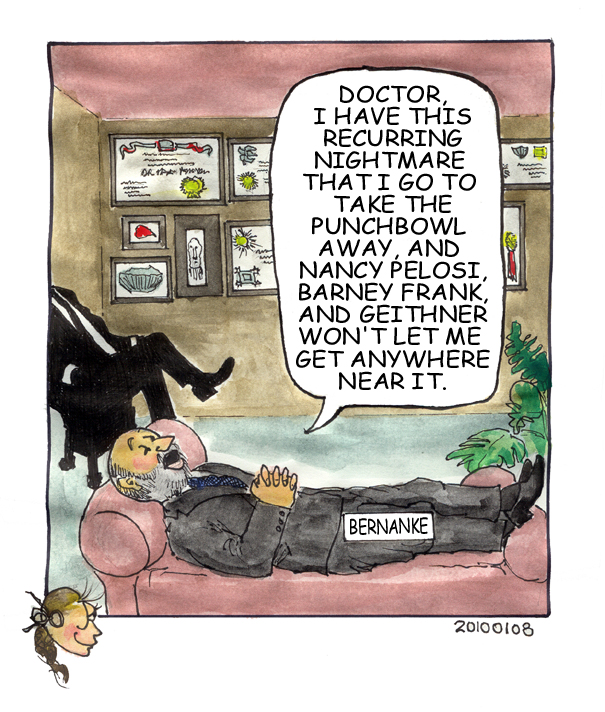
But Ben, A Bubble Has No National Boundaries
Ben Bernanke is showing himself to be more of a Big-Government politician than a scientist. In his latest speech, he has tried to defend the actions of his predecessors by claiming that their easy-money monetary policy only holds five percent of the responsibility for the high real estate prices that ignited the boom-and-bust bubble that almost broke the back of the global economy.
According to his analysis, 30 percent of the responsibility goes to what he has been calling the "global savings glut." The other 65 percent, he says, belongs to the inferior standards of the US mortgage market. Therefore, his argument seems to be saying that if we cure the standards we cure the problem.
He attempts to prove his point by demonstrating through charts that other countries had even looser monetary policy than the US, and yet they did not show a worse real estate boom; therefore, he concludes, loose monetary policy does not cause bubbles.
This sounds convincing, coming as it does from the highest-placed economic academician in the land. But his logic is flawed.
There are two problems with his argument. First, you cannot isolate these particular variables as he has done. To do so is the equivalent of saying Michael Phelps eats a lot, and he is not obese, therefore a high-calorie diet does not cause obesity. (Michael Phelps is the Olympic medalist swimmer who purportedly eats around 8,000-10,000 calories a day. A scientist could probably prove that he also spends almost 8,000-10,000 calories a day in his sports activities.)
Second, although Bernanke seems to accept the wisdom that a nation's monetary looseness can create excess purchasing media that can then chase relatively fewer goods, he doesn't seem to admit that there is no economic law that restricts a purchasing media's use to its country of origin, at least not in an immediate temporal sense.
Although US dollars must ultimately come to roost back in the US, they may station themselves in any number of places for many years (to wit, China's Current Account Surplus, for example) before they find their way here; and while so stashed, they can be used as collateral for any number of ventures in the meantime, in any currency--say, for example, to buy Spanish pesetas to be invested in Spain's real estate boom.
By the same token, a loose yen, for example, can go on a bubble-blowing spending binge in the US through the carry trade (borrowing in yen to obtain dollar-denominated instruments, or even cash dollars).
Bernanke's effort is a perfect example of the econometrician's Achilles Heel: narrow-sightedness. Markets are fluid, complicated, convoluted, multifaceted mishmashes of changing signals and events. For his analysis to work it must include a variable for each relevant event, not just an isolated one or two.
I find it strange that high-powered government officials feel justified in using such flawed science to defend themselves, even if they were to claim they do it for some lofty cause like the preservation of market confidence.
Labels: Bernanke, econometrics, housing bubble, monetary policy
Tuesday, February 02, 2010
Let’s atomize Wall Street...
Let’s atomize Wall Street, by Martin Hutchinson
Paul Volcker’s proposal that proprietary trading should be spun off from deposit-taking banks is a worthwhile step in the direction of stabilizing the financial services business. However, when you consider that business in detail, it becomes clear that further breakups are necessary in order to remove the excessive risks from the U.S. economic system.
Volcker became something of a hero to the left for his sponsorship of President Obama’s bank-bashing announcement. Indeed, I was very much hoping that he could ride this new-found enthusiasm through a defeat of Ben Bernanke in his Senate confirmation vote, followed by a more or less unanimous Senate approval of a Volcker nomination to replace him as Fed chairman. Assuming Volcker hadn’t suffered a Damascene conversion to sloppy monetary policy while I wasn’t looking, Obama and the left would be suffering buyer’s remorse within about an hour of Volcker’s arrival at the Fed, but by that stage the deed would be done. I was practicing my Dr. Evil laugh for this eventuality, but alas it was not to be.
There are three problems with the current setup on Wall Street: systemic risk, rent seeking and conflicts of interest. The Volcker proposal addresses the systemic risk problem to a great extent, but does not do much about the other two. For a complete solution, we thus need to go further.
When Treasury Secretary Larry Summers and former Senator Phil Gramm (R-Texas), among others, pushed through repeal of the Glass-Steagall Act in 1999, they didn’t give proper thought to the dangers of institutions funding a traders’ casino with guaranteed deposits. The introduction of Glass-Steagall in 1934 had been highly damaging to the economy, because it decapitalized the investment banks, killing off the capital markets for the remainder of the 1930s and playing a major role in prolonging the Great Depression. However, by 1999, the investment banks were more than adequately capitalized (provided they followed sound principles of risk management and leverage, which of course they increasingly didn’t). Thus, the rationale for allowing commercial banking and investment banking to be combined was shaky at best. It should have caused further doubt that the trigger for Glass-Steagall repeal was the acquisition of the investment bank Salomon Brothers by Citigroup, itself a quagmire of conflicts of interest that had been bailed out from bankruptcy only eight years before.
However, restoring Glass-Steagall as it was would achieve nothing. After all, the two most serious failures of risk management in the 2008 crash were collateralized debt obligations, involving a mortgage bond market in which commercial banks’ securitization operations have always been active, and credit default swaps, a product in which commercial banks were intimately involved from the first. Conventional underwriting of corporate debt and equity securities, the activity prohibited to commercial banks by Glass-Steagall, was not the problem, as it might have been had the crash occurred with the bursting of the 1999 dot-com bubble. The principal risks involved in finance today are those incurred by traders, but those proliferate in both types of banking.
It’s not clear how Volcker’s ban on proprietary trading in banks benefiting from deposit insurance would work. Every bank foreign exchange desk and money desk trades on the bank’s own account in almost every transaction it makes (relatively few transactions are pure brokerage between two counterparties.) Thus, however simple the bank’s operations, it cannot avoid “proprietary trading.” Of course you can ban separate “prop trading” desks, but in a naughty world that would drive the proprietary traders to integrate themselves into the operations of the various products concerned, thus negating the effect of the legislation.
The other problem with the Volcker proposal is that even without separate proprietary trading operations, the banks are undertaking risks which they don’t manage properly. Wall Street risk management systems are based on assumptions of Gaussian randomness in markets that are demonstrably far from realistic. In particular, Wall Street risk management systems understate the risk of several highly risky products such as collateralized debt obligations and credit default swaps. This understatement is in the interest of bank management, which benefits from state bailouts when it all goes wrong. It is even more in the interest of traders, who by and large make the most money from trading the riskiest instruments, and hence welcome artificially large position limits for those instruments. Since current Wall Street risk management methods are in the interest of those who work on Wall Street, they will not be changed except by regulatory means. Before their alteration they will, even without proprietary trading, leave the Wall Street behemoths in continual danger of explosion.
Rent-seeking is another current problem of Wall Street, not addressed by Volcker. This takes many forms, and has resulted from computerization and from the endless proliferation of derivative instruments. Basically, Wall Street houses, by their substantial market share in trading businesses, acquire insider information about money flows, and then profit by trading on this information. Traders have always done this, of course, and there is no sensible way of making it illegal. In addition genuine “crony capitalism” insider information about future finances and future government actions is as available as it always has been, but with larger trading volumes and fewer inhibitions is more usable without technically contravening insider treading legislation. Thus insider trading, almost all of it technically legal, has acquired an enormously magnified profit potential. This is the principal reason for Wall Street’s greater share of the economy; the genuine value added to third parties from “hedging” or liquidity” is only a tiny fraction of the rents Wall Street can extract from these markets.
There is no complete solution to this problem, but the best palliative is a “Tobin tax,” a modest ad valorem transaction tax on each trade. By this means, the profitability of “high speed trading” would be eliminated and many of the other insider trading strategies would be reduced in scope and profitability, particularly if the tax were levied on the nominal principal amount of a derivative and not on its theoretical value. This would in turn swing the power base within Wall Street away from traders and back towards bankers and corporate financiers, whose approach to life is more conducive to maximizing those houses’ genuine economic value added.
The final problem in the Wall Street behemoths, that of conflicts of interest, requires no legislative solution, at least as far as the corporate customers are concerned, but only that the financing business remain adequately competitive. With behemoths doing corporate financing transactions, any of their customers is faced with huge conflicts in dealing with them. If a company provides them with sensitive corporate data, it may be subjected to a leveraged buyout. If a company entrusts them with a new financing, it may find their trading operation shorting it, either directly or indirectly. (Those mortgage originators and investors still in business, for example, can reasonably feel miffed with Goldman Sachs making a profit from shorting subprime mortgage bonds through the CDS market while it was at the same time issuing and selling new ones). Wall Street pretends to operate internal “Chinese walls” through which sensitive information does not penetrate, but to rely on those is to put yourself entirely under the protection of Wall Street’s ethical integrity, a security currently trading at a very substantial discount.
The solution to these conflicts of interest is “single capacity,” the system under which the City of London acted until the passage of the Financial Services Act of 1986, surely among the most misguided legislation in human history. Under this system brokers, who sold securities, were kept separate from jobbers, who made markets in them. Both were separate from merchant bankers who arranged financings and carried out mergers and acquisition transactions. When an underwriting took place, the merchant bank arranged the transaction and the brokers sold the underwriting to insurance companies and other large investment institutions, who earned additional income by backstopping deals in this way. “Proprietary trading” was undertaken by investment trusts, pools of money whose business was to maximize income for their investors, in a similar way to a U.S. hedge fund. As for banking, that was done by the merchant banks if complicated, but the high volume simple transactions were carried out by the clearing banks, home of the nation’s retail deposits but not known for their intellectual heavy lifting.
It worked beautifully, just as well as the modern system, indeed better. It cost far less, in terms of the wealth it extracted from the economy. It was much less risky. And there were few conflicts of interest; each participant in the business, having only one function and capability, was devoted to its own interest rather than torn between the interests of several participants in every transaction.
This system is to some extent returning anyway, with the increasing market share of “boutique” investment banks such as Greenhill & Co. and Evercore Partners, which at least have fewer conflicts of interest than the behemoths. However, a regulatory “nudge” or two would be no bad thing.
As I said, Volcker had a good idea, but he did not go nearly far enough.
The Bears Lair is a weekly column that is intended to appear each Monday, an appropriately gloomy day of the week. Its rationale is that, in the long ’90s boom, the proportion of “sell” recommendations put out by Wall Street houses declined from 9 percent of all research reports to 1 percent and has only modestly rebounded since. Accordingly, investors have an excess of positive information and very little negative information. The column thus takes the ursine view of life and the market, in the hope that it may be usefully different from what investors see elsewhere.
Martin Hutchinson is the author of “Great Conservatives” (Academica Press, 2005). Details can be found on the Web site www.greatconservatives.com.
Subscribe to:
Posts (Atom)